How to Report Crypto on Your Taxes in 2026: Five Easy Steps

 Expert verified
TokenTax content follows strict guidelines for editorial accuracy and integrity. We do not accept money from third party sites, so we can give you the most unbiased and accurate information possible.
To report crypto on your 2025 federal tax return filed in 2026, gather complete records from every exchange, wallet, and on-chain app.
Separate transfers from taxable transactions, calculate each capital gain or loss, and report applicable disposals on Form 8949 and Schedule D.
Report crypto received from staking, mining, airdrops, compensation, and similar activities as ordinary income at its fair market value when you gain control of it. That amount becomes your cost basis for a later sale, swap, or spend.
Reconcile Form 1099-DA against your own transaction history. Brokers report basis only for covered assets, so most of what you hold still needs your own records.

Why trust our crypto tax experts
Crypto tax reporting at a glance
The IRS treats cryptocurrency like property, like stocks. This means US taxpayers must:
Track crypto gains and losses upon disposal
Report any crypto income received
For a compliant crypto tax filing, keep your complete transaction history across exchanges and platforms and follow these steps:
Step | Process | Result |
1 | Export your full history from every exchange, wallet, and on-chain app you used | One complete list of trades, transfers, income, and fees |
2 | Match and label transfers between your own accounts so they do not get treated like sales | Clean data with fewer missing cost basis issues |
3 | Calculate gains and losses for every taxable disposal (sell, swap, spend) | A gain or loss for each disposal, plus short-term vs long-term totals |
4 | Generate Form 8949 details (often as a report or attachment) and carry totals to Schedule D | Form 8949 output plus Schedule D totals that flow to Form 1040 |
5 | Report any crypto income on the right line, finish the return, and save backups | Form 1040 completed, income reported, exports and reports saved |
In-depth: five essential steps to file your crypto taxes fast
Here’s a closer look at the five critical steps for accurate and compliant crypto tax filing in the US.
Step 1: Collect your crypto records before you calculate anything
Start by exporting CSVs from every centralized exchange you used. Then export transaction history from each wallet you controlled. If you used DeFi, include on-chain activity such as swaps, bridges, LP activity, and mints.
Accuracy is critical. Missing transactions often create missing cost basis, and missing cost basis can make your gains look larger than they really were.
Step 2: Separate taxable disposals from non-taxable transfers
Before you run any math, make sure you can tell the difference between:
Transfers: moving crypto between wallets or accounts you control and
Disposals: selling for USD, swapping one coin for another, or spending crypto
Transfers are typically not taxable in themselves, but they matter because they link your crypto cost basis and holding period to the eventual disposition. Complete and accurate records are necessary.
Step 3: Calculate gains and losses for each taxable disposal
For each taxable disposal, you generally calculate:
Proceeds: what you received at the time of disposal (usually fair market value), minus selling fees
Cost basis: what you paid, or what the crypto was worth when you received it, plus acquisition fees
Example: sale for fiat
You bought 1 ETH for $2,000 plus a $20 fee.
You later sold it for $2,600 and paid a $20 selling fee.
Basis is $2,020. Proceeds net of fee are $2,580.
Your capital gain is $560, either short-term (if you held for a year or less) or long-term (if you held for more than a year).
Example: crypto-to-crypto swap
Let’s say you bought 15 SOL at $48 each and paid a $3 fee, so your total basis is $723.
You later swap the 15 SOL for BTC when SOL is $60, so the gross value is $900.
Assuming the $12 swap fee is deducted from the SOL you sold, your proceeds are reduced to $888.
This means your short- or long-term capital gain is $888 − $723 = $165, with a new BTC cost basis of $888.
Step 4: Generate the tax forms
This is the part most consumers misunderstand. You report crypto disposals on Form 8949 (often as an attachment) and summarize on Schedule D. Most filers handle it like this:
Do not hand-enter every trade unless you truly have to.
If you have extensive activity, you typically attach a transaction statement generated by crypto tax software (like TokenTax), then carry the totals to Schedule D.
If you have only a few disposals, you can enter them directly, but many people still prefer software, so totals flow correctly.
If you receive Form 1099-DA, use it to cross-check but not as your only source of truth. Check the covered indicator first. If the asset is noncovered, the basis field will be blank or marked as not reported, and you supply the number.
Step 5: Report crypto income, finish Form 1040, and save your backup
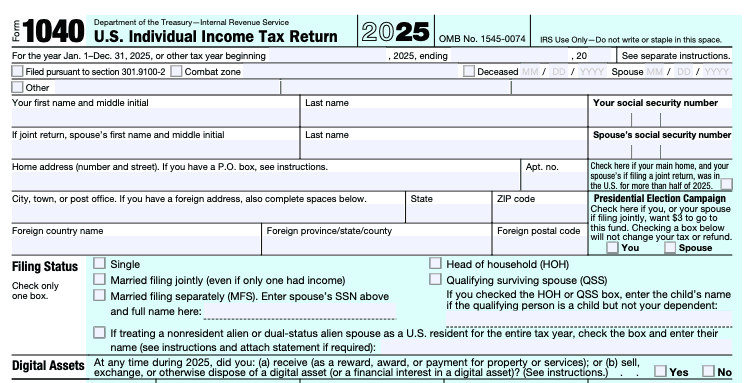
If you received crypto as income, you generally report the fair market value in USD when you can control the asset. Many filers report smaller, non-business activity on Schedule 1, line 8v, while business activity with a profit motive often goes on Schedule C.
Then complete the return, accurately answer the digital asset question on Form 1040, and save the exported files and reports you used. Save the exact CSVs, wallet exports, and reports you used. This is what you’ll want on hand should you face a crypto tax audit.
Pro tip
Timing your sales matters. Consider our guide to cashing out and crypto taxes to develop a winning strategy.
Relevant crypto tax forms
Here’s a breakdown of the common, relevant crypto tax forms the typical US crypto trader might see.
Form | What it covers | When you use it |
Form 8949 | Each crypto sale, swap, or spend with dates, proceeds, basis, and gain or loss | When you disposed of crypto |
Schedule D | Net short-term and long-term totals from Form 8949, plus carryforwards | When you have capital gains or losses |
Form 1040 | Main return, includes the digital asset question and totals | Every filer |
Schedule 1, Line 8v | Digital assets received as ordinary income not reported elsewhere | When applicable |
Schedule C | Business income and expenses (some mining, node ops, services) | When applicable |
Form 1099-DA | Broker reporting for digital asset sales. Basis is included only for covered assets. | If you receive it from a broker or exchange, use it to reconcile totals |
Form 1099-MISC | Certain bonuses or rewards, depending on the platform | If issued |
Form 1099-K | Payment settlement reporting from platforms | If issued |
Pro tip
A 1099 crypto form is an information return that reports some crypto sales or income to you and the IRS. Use it as a starting point for your tax reporting. It is not meant to be a complete record of everything you did across wallets and exchanges.
What counts as taxable activity for crypto?
Disposals: selling crypto for cash, swapping one coin for another, or spending. These can create capital gains or losses.
Income: getting paid in crypto or receiving rewards, like staking, mining, interest, referral bonuses, and airdrops. These typically create ordinary income at fair market value upon receipt and control of the coins.
Moving crypto between wallets you control does not, by itself, create a taxable event. Still, you want those transfers labeled correctly so your crypto cost basis is not misstated.
Current tax rates for cryptocurrency
Tax rates vary by state and territory and do change annually. See our crypto tax guide for current short- and long-term federal rates.
What to expect from the new Form 1099-DA
Form 1099-DA is a broker tax form for certain digital asset dispositions. If you receive one, use it as a helpful cross-check, but do not assume it captures your full tax picture. Brokers only report the cost basis for covered digital assets, meaning those acquired on or after January 1, 2026, and held continuously with that broker. Anything you bought earlier or transferred in is noncovered, and the basis field will be blank or marked as not reported.
Keep your own records as the source of truth, and reconcile any broker-form totals back to your transaction history.
Do I need to report crypto on my tax return?
Yes, always. If you disposed of crypto or earned token income, you must report it. That includes tiny trades and small rewards.
If you only bought and held without earning or selling, you generally do not have a reportable event, but you should always answer the digital asset question on Form 1040 accurately.
How are my crypto transactions taxed?
For US taxpayers, disposals result in crypto capital gains or losses based on holding period and netting rules. Short-term gains are taxed at ordinary rates; long-term gains are taxed at preferential rates.
Income in tokens is ordinary income at the value when received and becomes the basis for future gain or loss when you dispose of those tokens.
How much crypto do I need to report to the IRS?
There is no dollar threshold for reporting gains, losses, or income. A $5 taxable event still needs to be reported on your return.
Platform forms help, but they do not replace your own records. Keep dates, amounts, fees, and wallet addresses so totals reconcile.
Tax implications of crypto scams and exchange shutdowns
Losses tied to crypto hacks, scams, and exchange failures turn on why you parted with the crypto. If you transferred it as part of an investment, the loss may qualify under section 165(c)(2) and be reported on Form 4684, Section B. If the transfer was personal, it falls under the casualty rules and is generally not deductible. See our guide to crypto tax deductions for the conditions and documentation.
If you think you may have a deductible loss, document everything: wallet addresses, transaction hashes, platform statements, support tickets, and any legal claims.
Can I get a detailed statement of my crypto transactions for tax purposes?
Yes. Centralized exchanges typically provide CSVs and year-end tax documentation, including the new 1099-DA.
You can also export crypto wallet histories and save on-chain transaction hashes. DeFi users can access the blockchain itself through tools like Etherscan.
Why detailed crypto reporting matters
You’re responsible for your own crypto tax reporting, which is why you need to understand and keep your own transaction records.
Discrepancies can raise red flags and result in a crypto tax audit, which of course everyone wants to avoid. If you ever undergo an audit, having thorough records at hand will make the process much less stressful.
What platforms provide statements?
Major crypto exchanges provide annual reports and CSVs, and since the 2025 tax year they also issue Form 1099-DA.
Wallet apps typically allow you to export histories, and block explorers like Solscan and Etherscan will provide address-level activity for your DeFi crypto wallets.
How to submit: all transactions vs. summary sheet?
You can enter each line on Form 8949 or attach a detailed statement and put subtotals on the form. Either method is fine if the attachment includes all required fields.
Regardless, ensure your calculations are accurate. Keep the exact files you used in case the IRS requests support. When in doubt, speak with one of our crypto tax experts.
How TokenTax can help
TokenTax lets you gather all your exchanges and wallets into one place so you can file with confidence. You get unlimited integrations, AI-powered reconciliation, AI CSV support, tax loss harvesting, tax liability previews, automatic version history, and tax year number freezes.
Our secure platform then generates the crypto tax outputs you need, including Form 8949, an Income Report for mining, staking, and airdrops, FBAR for foreign accounts, international tax forms, and direct exports to file with TurboTax and TaxAct.
If you need hands-on help, our crypto tax experts are available.
How to report crypto on taxes FAQs
Do I need to report crypto on taxes in the US?
How do you report crypto on taxes in the US?
What crypto tax forms do I use for crypto tax reporting in the US?
Are crypto-to-crypto trades taxable in the US?
Is transferring crypto between your own wallets taxable in the US?
Are staking rewards taxable when you receive them in the US?
Do you pay capital gains tax when you sell staking rewards in the US?
What is Form 1099-DA for US taxpayers and will it be enough to file my crypto taxes?
Do crypto exchanges report to the IRS in the US?
To stay up to date on the latest, follow TokenTax on Twitter @tokentax.
Related Content
