Your 1099-DA Is Missing Cost Basis. Here's How to Rebuild It

 Expert verified
TokenTax content follows strict guidelines for editorial accuracy and integrity. We do not accept money from third party sites, so we can give you the most unbiased and accurate information possible.
A missing cost basis on Form 1099-DA isn't necessarily an error. Brokers weren't required to report basis for 2025 sales. Starting in 2026, mandatory basis reporting applies to covered digital assets.
A blank cost basis doesn't mean your crypto cost $0. You'll need to reconstruct your actual basis using purchase records, transaction histories, and transfers between wallets and exchanges.
Reconcile your crypto transactions in three steps. Match the proceeds on each 1099-DA to your records, rebuild missing or incorrect cost basis, and account for taxable transactions that weren't reported on a form.
Cost basis must be tracked wallet by wallet. Rules effective January 1, 2025, ended universal pooling across accounts. If you previously pooled basis, review your records and any allocation made under Rev. Proc. 2024-28.
Your tax return doesn't have to match an incorrect 1099-DA. Use your documented figures on Form 8949, make the appropriate adjustments, and request a corrected form when the broker reports an actual error.

Why trust our crypto tax experts
If your 1099-DA is missing cost basis, that's by design. It's up to you to reconcile the missing data on the form and have an accurate record of your crypto transactions. You must do this on a wallet-by-wallet basis. In 2025, the first year of that rule, brokers had to report proceeds but not basis, so the gap between the form and your return is at its widest, and the three passes close it below: proceeds, basis, then what no form shows.
What Form 1099-DA actually reports
Form 1099-DA, Digital Asset Proceeds From Broker Transactions, is filed by brokers, such as custodial exchanges, for each sale or exchange they handle on your behalf. The IRS gets a copy, and so do you. For 2025 sales, the instructions call for "mandatory reporting of gross proceeds information and voluntary reporting of basis information." For who sends the form and when, see Form 1099-DA.
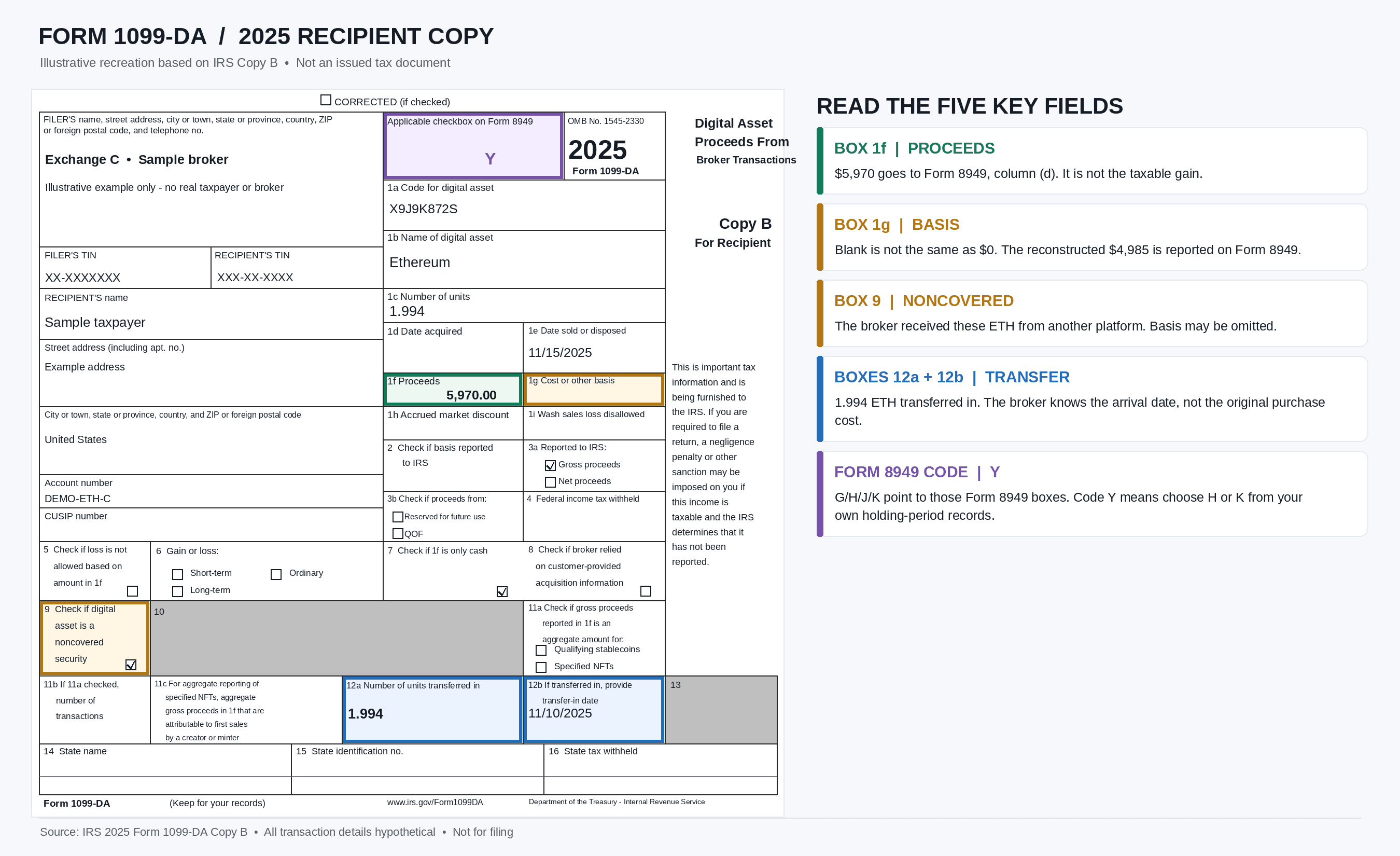
Here is how to read Form 1099-DA box by box.
Box | Label (2025 form) | What the broker fills in | Often blank because… |
Applicable checkbox on Form 8949 | - | A code (G, H, J, K, or Y) pointing to your Form 8949 box | - |
1a / 1b | Code for digital asset / Name of digital asset | Token identifier and name | - |
1c | Number of units | Units sold | - |
1d | Date acquired | Acquisition date | Not required for 2025, noncovered asset, or multiple dates |
1e | Date sold or disposed | Sale date | - |
1f | Proceeds | Gross proceeds, reduced by transaction costs | - |
1g | Cost or other basis | Basis | Not required for 2025, or noncovered |
2 | Check if basis reported to IRS | Checked when basis is reported | Basis not reported |
4 | Federal income tax withheld | Backup withholding | No withholding |
6 | Gain or loss: Short-term / Long-term / Ordinary | Type of gain or loss | Holding period unknown to the broker |
7 | Check if 1f is only cash | Sale for cash | Swap for another asset |
9 | Check if digital asset is a noncovered security | Asset is noncovered | Covered asset |
11a / 11b | Check if gross proceeds reported in 1f is an aggregate amount for: Qualifying stablecoins / Specified NFTs; If 11a checked, number of transactions | Combined proceeds and the number of sales behind them | Sales reported one by one |
12a / 12b | Number of units transferred in / If transferred in, provide transfer-in date | Units moved in from elsewhere, and when | No transfer-in |
Start with quantity. Check box 1c against your records before comparing dollar amounts. If you sold 0.5 BTC and the form says 0.7 BTC, resolve that first.
Box 1f is the number the IRS matches against your return. It's what the broker says you received, which can be cash, another digital asset, or other property. Proceeds aren't profit. If you bought crypto for $7,000 and sold it for $10,000, your gain starts at $3,000, before fees.
Box 1g is where reconciliation happens. The instructions tell brokers to "enter -0- in box 1g only if the digital asset sold actually had a basis of zero." A blank 1g means basis wasn't reported. A $0 entry was reported to the IRS as your basis. If that's not your real basis, you correct it on Form 8949.
Boxes 12a and 12b mark the coins the broker received from elsewhere. The broker knows when they arrived, but not what you paid for them. That makes these boxes a useful starting point when you rebuild basis.
Aggregate reporting. Qualifying stablecoin and specified NFT sales can be reported as one combined total. When box 11a is checked, box 1f shows the total, and box 11b shows the number of sales behind it. Compare it with the underlying trades instead of expecting a separate line for each.
Why cost basis is blank: covered vs. non-covered assets
Brokers only have to report basis for covered assets. Under the Form 1099-DA instructions, a covered asset is crypto acquired on or after January 1, 2026, in an account where the broker provided custodial services, and held there until the broker sold it. Everything else is noncovered:
crypto acquired before January 1, 2026;
crypto transferred in from another wallet or exchange;
crypto the broker didn't hold in custody.
The effect by year:
2025 sales: gross proceeds only. Basis reporting was voluntary for every asset.
2026 sales and later: basis is mandatory for covered assets only.
Anything bought before 2026, or moved in from elsewhere, stays noncovered for as long as you hold it. That includes crypto you bought in 2026 at one exchange and then moved to another. Say you bought SOL on an exchange in 2024, bought more on the same exchange in March 2026, and sold all of it in 2027. The 2027 form can show basis for the 2026 units, but likely not the 2024 units. Those may appear as a separate line with box 9 checked and box 1g blank, and they'll keep coming back blank for years.
None of this changes your actual basis or what you owe. It only changes where the number comes from: the broker, or your own records. A broker may still report basis voluntarily on a noncovered sale. If it does, check that figure against your records like any other.
A blank basis field is not a reason to request a corrected form. It's a reason to find the original purchase.
The wallet-by-wallet rule and why 2025 basis is harder
From January 1, 2025, Treas. Reg. §1.1012-1(j) requires you to figure basis wallet by wallet and account by account. A sale on one exchange can only use lots held in that same account. Before 2025, many people used a "universal" method, pooling every purchase of a coin across all platforms. That method no longer works, and people who used it were left with pooled basis that wasn't tied to any particular wallet.
Rev. Proc. 2024-28 was the bridge. It's a safe harbor for allocating "unused basis" from pooled records to the units actually sitting in each wallet and account as of January 1, 2025, as long as the allocation was reasonable. It allowed two approaches:
Specific unit allocation: assign specific lots to the units in each wallet. This had to be completed before the earlier of:
your first sale, disposition, or transfer of that type of asset on or after January 1, 2025, or
the due date of your 2025 return, including extensions.
Global allocation: apply a rule that orders your lots and assigns them to wallets. The rule had to be written into your records before January 1, 2025, and the allocation completed before the later of those two dates. Until the allocation was complete, a sale of those units counted as identified only under a standing order recorded in your books or given to your broker.
Either way, the allocation can't reuse basis already consumed by earlier sales, and once made, it's irrevocable. Rev. Proc. 2024-28 doesn't call this an election, and the safe harbor doesn't establish how much basis you have. You still have to substantiate the basis itself.
For 2025 returns, the due date was April 15, 2026, or October 15, 2026, for those who filed an extension. If you sold, swapped, or transferred an asset during 2025, the specific unit deadline for that asset already passed at that first transaction. As of November 2026, the IRS hasn't extended either deadline. Notice 2026-20 extends a different relief (lot identification at brokers) and says it applies only after any Rev. Proc. 2024-28 requirements you rely on are met.
If you didn't make a safe harbor allocation, you can't rely on its protection, but your basis isn't lost. Your per-wallet basis has to stand on your own records under the regulation. That means a reasonable method, applied consistently, that traces which lots ended up in which wallet, supported by transaction history. Don't create an allocation now and date it as if it were timely. If the amounts are material, have a tax professional review it. More in crypto cost basis.
Within each wallet, you still choose which units you sold. Through December 31, 2026, Notice 2025-7 (extended by Notice 2026-20) lets you identify units held at a broker in your own books and records by the time of sale, or by a standing order recorded beforehand. Without an identification, FIFO applies within that account. Average cost isn't an allowed method for crypto. Because of this relief, the basis a broker reports and the basis you correctly identify can differ. See crypto accounting methods.
The split between your records and the broker's can outlast the relief. If you identified different lots than your broker did, the broker's list of what you still hold won't match yours. This can happen even if you never moved your coins. Say you bought 1 BTC on an exchange in January 2026 for $60,000 and another in March for $90,000. In June you sold one, identifying the $90,000 coin in your records, while the exchange applied FIFO and reported the $60,000 coin. Both records show 1 BTC left. Your records say it cost $60,000, and the exchange's say $90,000. When you sell it in 2027, the 1099-DA will report $90,000 of basis, and your records support $60,000. The difference can work against you as well as for you.
Starting January 1, 2027, an identification for coins an exchange holds counts only if you give it to the exchange by the time of the sale, either for that sale or through a standing order. If the exchange offers only one identification method, that method is treated as your standing order. Without an identification, FIFO applies. Set a standing order at each exchange that matches the method you use, keep reporting from your own lot records, and correct any 1099-DA basis that disagrees with code B on Form 8949.
Before you start: what to gather
Collect everything first, so each pass runs without backtracking. Keep originals unedited and work on copies.
Every Form 1099-DA you received, plus any 1099-MISC for rewards. Note any marked CORRECTED.
Full-history CSV or API exports from every exchange, including closed accounts. Year-only exports miss the purchases that set your basis.
Public addresses for every self-custody wallet (never your seed phrase)
Records from before 2025, and any Rev. Proc. 2024-28 allocation you documented
Lot-identification records or standing orders for 2025 sales
Bank and card statements showing crypto purchases
Prior-year Forms 8949 that include crypto
A list of DeFi protocols, bridges, and chains you used, with the wallet address used on each
Records of crypto loans or collateral, including any liquidation notices
Any IRS letters or notices (see IRS crypto letters 6173, 6174 and CP2000)
Sort the records by platform and year. Don't delete records that look like duplicates until you've confirmed they aren't the same event recorded in two places, such as a withdrawal on one exchange and the matching deposit on another.
Pass one: tie your proceeds to each form
If your 1099-DA doesn't match your records, start with proceeds, since that's the figure the IRS already has. Work one form at a time:
For each Form 1099-DA, total box 1f.
Pull the same broker's sales for the year from your export or tax software.
Compare them by asset and by date, not only in total.
Comparing in total can hide errors. Say Exchange A reports $18,000 in proceeds and Exchange B reports $12,000, while your records show $17,500 and $12,500. Both add up to $30,000, but neither broker ties out, and each gap needs an explanation.
Transfers read as disposals. A withdrawal to your own wallet can show up as a sale, either on the form or in your software. Check the on-chain transaction. If the coins landed in a wallet you control, it isn't a sale. Fix the classification in your software, or ask the broker for a corrected form if the broker reported it. Only the network fee is a disposal.
Loan collateral. Crypto pledged to a lending platform shows as a sale if the platform liquidated it. A liquidation is a disposal, and the platform's form should show it. A deposit you can still reclaim may not be a disposal. The IRS hasn't issued specific guidance on crypto collateral, so document the loan terms and treat them consistently.
Pricing-source variance. On a crypto-to-crypto swap at a broker, box 1f reflects the value of what you received, at the broker's price and timestamp. Your software may use a different source, so small gaps are normal. Use the broker's figure in Form 8949 column (d), since that's what the IRS sees. If you have documented reason to think it's wrong, ask the broker for a correction rather than overriding it.
Fees. Box 1f should already be reduced by transaction costs: costs on a sale or swap reduce proceeds. If you paid a fee the form doesn't reflect, keep column (d) as reported and show the fee as an adjustment with code E.
Move on when each form ties out, or every difference is explained in writing.
Pass two: rebuild your cost basis
For each sale with a blank or wrong box 1g, trace the units back to where you acquired them:
Carry the original basis and acquisition date forward through every wallet they passed through.
Basis is what you paid, plus fees on a cash purchase.
Transfers move basis but don't create it, and crypto spent on a transfer fee is a small disposal.
The source of the coins matters. For crypto you received as income, such as staking rewards or pay, basis is the fair market value you reported as income when you received it. Gifts and inheritances follow their own basis rules, so don't assign them a purchase price.
Apply lot identification within each wallet as the rules require: a valid Rev. Proc. 2024-28 allocation for pre-2025 holdings, then your identifications or FIFO for each sale. Don't switch lots after a sale because a different lot would produce a smaller gain.
Worked example (hypothetical prices):
Buy on Exchange A (Feb 10, 2025): 2 ETH for $4,980 cash plus a $20 fee. Basis: $5,000 ($2,500 per ETH).
Withdraw to Exchange B: Exchange A charges a 0.004 ETH withdrawal fee, with ETH at $2,600. That's a disposal:
proceeds $10.40, basis $10.00 (0.004 × $2,500), gain $0.40;
1.996 ETH arrives at Exchange B, basis $4,990.
Withdraw from Exchange B to Exchange C: Exchange B charges 0.002 ETH, with ETH at $2,800:
proceeds $5.60, basis $5.00, gain $0.60;
1.994 ETH arrives at Exchange C, basis $4,985, still dated Feb 10, 2025.
Sell on Exchange C (Nov 2025):
1.994 ETH at $3,000 = $5,982, minus a $12 trading fee = $5,970 proceeds;
gain: $5,970 − $4,985 = $985, short-term (held one year or less).
Check:
Total proceeds: $5,970 + $10.40 + $5.60 = $5,986.
$5,986 minus total basis of $5,000 = $986.
That equals $985 + $0.40 + $0.60.
Three platforms, three forms, one true basis.
Exchange A's 1099-DA: if A reports crypto used to pay withdrawal fees, the form shows the 0.004 ETH fee as a sale, with $10.40 in proceeds and box 1g likely blank. Coinbase, for one, reports fees paid this way. A doesn't report the withdrawal itself, because moving coins to your own account isn't a sale.
Exchange B's 1099-DA: may report the 0.002 ETH fee the same way, with $5.60 in proceeds. Box 12a may show the 1.996 ETH you transferred in. The coins that passed through B weren't sold there.
Exchange C's 1099-DA: box 1f $5,970, box 1g blank, box 9 checked, box 12a 1.994 ETH transferred in.
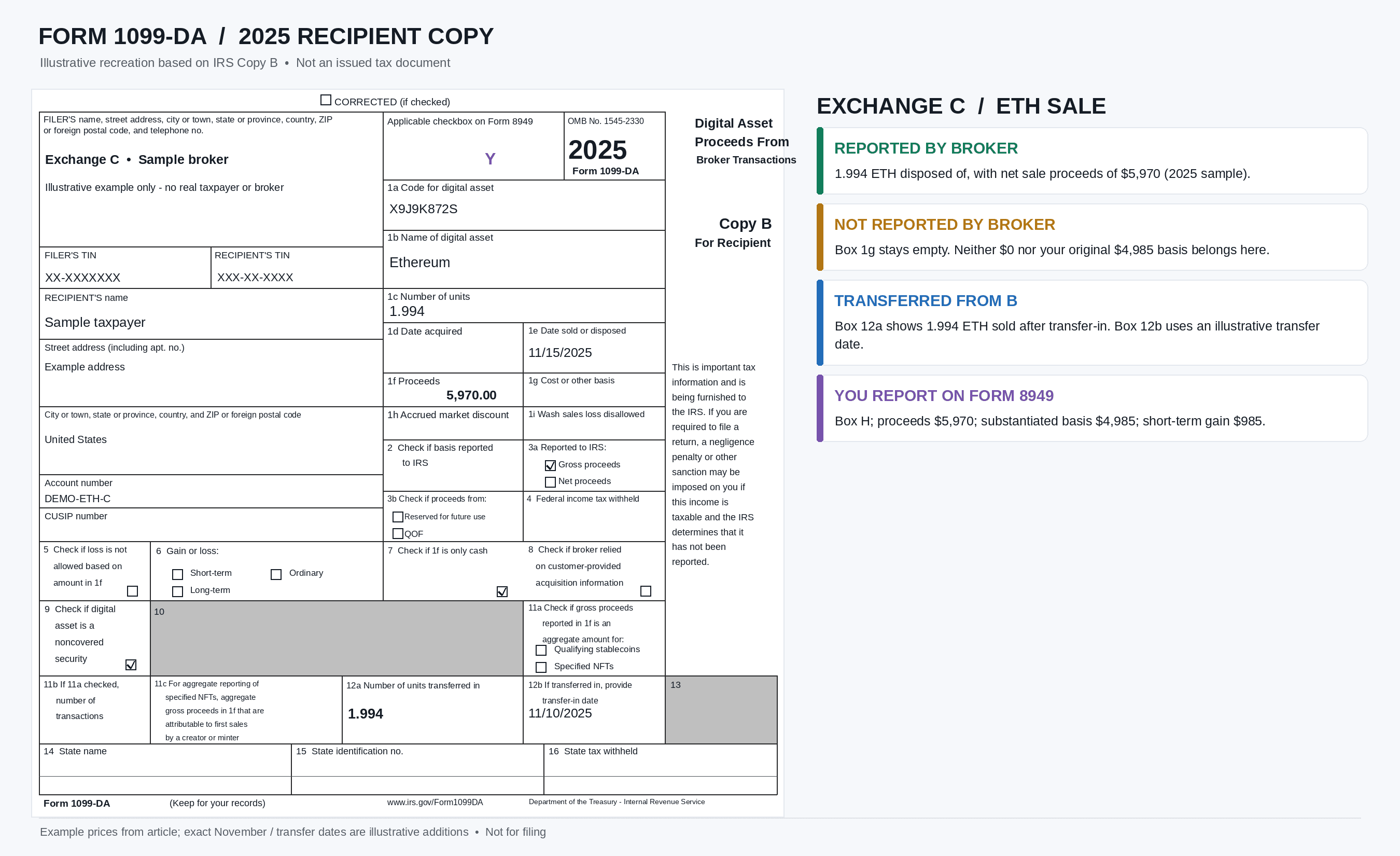
A's and B's forms add no income beyond the two fee sales, which total $1.00 in gain. The 2 ETH you bought moved through those accounts but was sold only once, on Exchange C. On the return, the figure that matters is $4,985 in column (e) against Exchange C's $5,970, taken from your Exchange A purchase record. The two fee sales go on Form 8949 box H with your basis. If an exchange didn't report its fee sale, it goes in box I instead. If a form ever shows the transfer itself as a sale, that's a form error (see "When the form itself is wrong").
When your basis differs from the broker's. First check box 2 to see whether the broker reported basis to the IRS. If it didn't, enter your supported basis directly. If it did and the figure is wrong, Form 8949 has an adjustment process that keeps the broker's number on the return and reconciles it to yours (covered below). That includes covered sales where the broker matched different lots than you identified. Keep a note of the lots, the transfers, and the reason for each difference, because the same difference will carry into later years.
Pass three: the transactions no form will show you
A Form 1099-DA only covers sales a custodial broker handled. Self-custody wallets and decentralized protocols don't issue one, and no form doesn't mean no tax. Congress repealed the rule that would have required DeFi front-end providers to report as brokers, under the Congressional Review Act (Pub. L. 119-5, April 10, 2025). Treasury and the IRS removed it from the regulations effective July 11, 2025. The Congressional Review Act also bars Treasury from issuing a substantially similar rule without new legislation, so no form is coming for this activity.
Separately, the IRS has given brokers temporary exceptions from reporting certain staking, lending, liquidity, and wrapping transactions (see the IRS digital assets page). Those exceptions affect what brokers report, not whether the activity is taxable.
DEX swaps: each swap is a disposal of the token you gave up, at the fair market value of what you received. Swap fees reduce proceeds.
Liquidity provision: depositing tokens for LP tokens may be a disposal. The IRS hasn't addressed it directly. Choose a reasonable treatment, document it, and apply it consistently.
Bridging: moving the same asset across chains is generally treated like a transfer, but a bridge that hands you a different token may be a swap. The IRS hasn't addressed it, so document the treatment you use.
On-chain income: staking rewards, airdrops, and similar receipts are ordinary income at fair market value when you gain dominion and control. Report them on Schedule 1, line 8v (or Schedule C if it's a business), never on Form 8949. That value becomes your basis.
Disposals from this pass go on Form 8949 box I (short-term) or box L (long-term). See the DeFi tax guide.
When basis can't be rebuilt: your options, ranked
Sometimes records are gone: a closed exchange, a lost wallet history, years-old trades. The options below are ranked by how well each holds up, not by the tax result. A blank basis on the form isn't $0 basis, so report your actual basis wherever you can document it.
Documented reconstruction. Rebuild basis from secondary evidence: bank and card statements, emails and receipts, on-chain history, archived exchange data. A bank transfer to an exchange on a known date, matched to an on-chain deposit, often pins down a purchase even when the exchange's own records are gone. Funding an account alone doesn't prove what you bought, so you need a link between the payment and the purchase.
Cost: the most time.
Result: the easiest position to support.
A reasonable good-faith estimate, with support. Where pieces are missing, estimate using a documented method you apply consistently, such as historical prices for a date range your bank records confirm. Keep written notes on the method. Apply the same method to every lot it covers; don't pick a different method for each lot. Market prices can show what a coin cost on a date, but not that you bought it rather than received it as income or a gift.
Cost: less time than full reconstruction, but weaker evidence. Expect to defend it if asked, and have a tax professional review it if the amounts are material.
Zero basis. If you can't support any basis, reporting $0 is the conservative fallback. The IRS may treat unsupported basis as zero anyway.
Cost: you report the full proceeds as gain, often the highest tax of the three. A coin sold for $25,000 with a real $20,000 basis produces a $5,000 gain; at zero basis, the reported gain is $25,000.
Result: there's nothing left to dispute.
You can mix approaches: reconstruct what you can, estimate a documented remainder, and use zero only for lots with no evidence at all. Record which approach applies to which lots.
More on reconstruction in crypto cost basis.
Missing cost basis across several platforms? TokenTax's team can help trace it. See TokenTax VIP
Putting reconciled figures on Form 8949
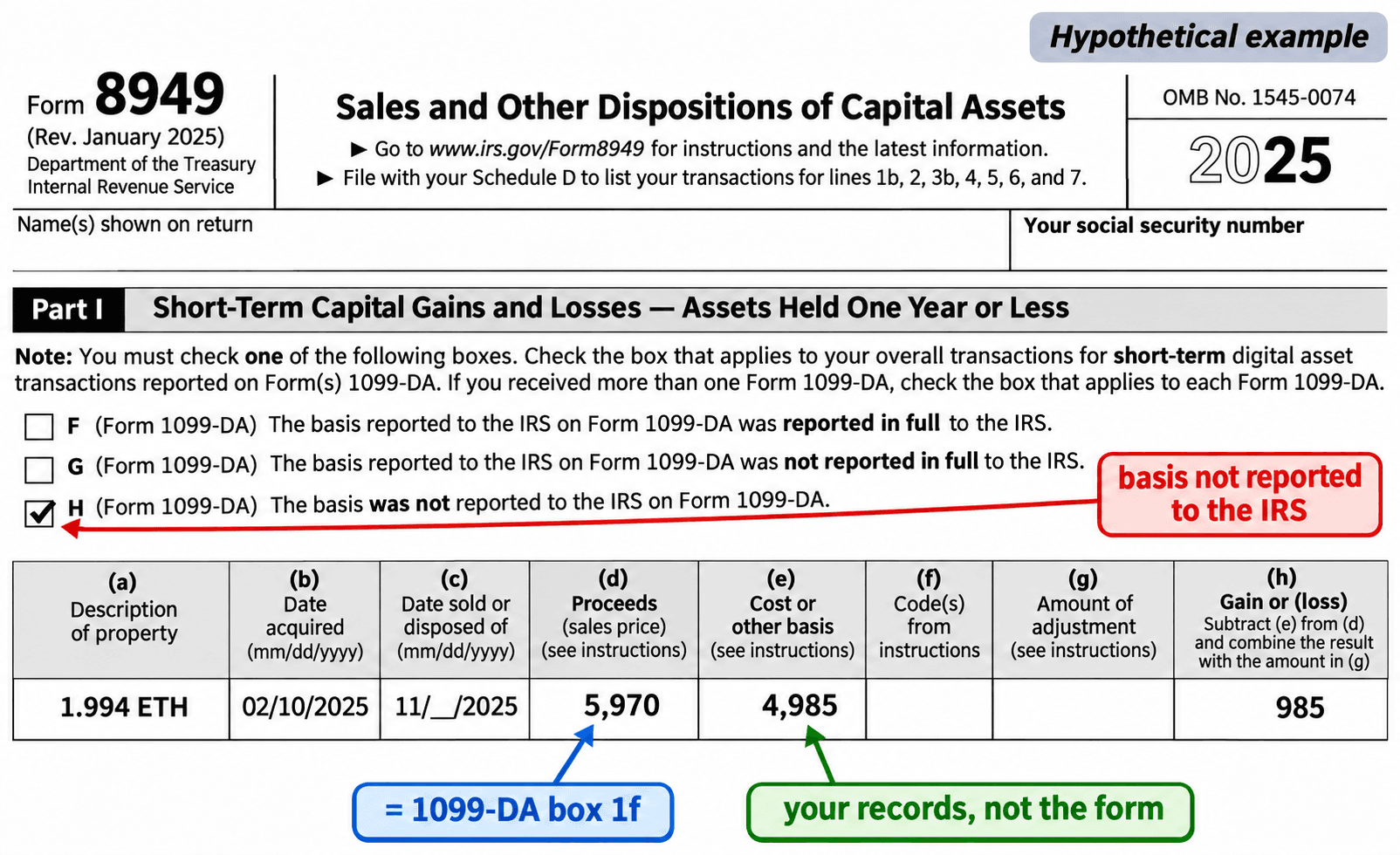
The 2025 Form 8949 has separate boxes for digital assets. Don't use boxes C or F for crypto.
Box | Use for | Schedule D line |
G (short-term) / J (long-term) | Form 1099-DA sales where basis was reported to the IRS | 1b / 8b |
H (short-term) / K (long-term) | Form 1099-DA sales where basis wasn't reported to the IRS | 2 / 9 |
I (short-term) / L (long-term) | Digital asset sales not reported on a 1099-DA or 1099-B | 3 / 10 |
The code in the 1099-DA's "Applicable checkbox on Form 8949" tells you where the sale goes. G, H, J, and K point to that box directly. Code Y means the broker didn't report basis and doesn't know your holding period, so you choose box H or K from your own records. For 2025 sales, brokers that didn't report basis use code Y, so expect to see it on most 2025 forms.
Column by column:
(a) description (e.g., "1.994 ETH")
(b) date acquired, from your records
(c) date sold
(d) proceeds, equal to box 1f
(e) cost or other basis
(f) code
(g) adjustment
(h) gain or loss
The common cases, per the Form 8949 instructions:
Box H/K, basis blank: enter your basis in column (e). No code is needed.
Box H/K, basis shown but wrong: enter the correct basis in (e), code B in (f), and -0- in (g).
Box G/J, basis wrong: enter the reported basis in (e), code B in (f), and the correction in (g). If the broker reported $4,000 and your supported basis is $5,000, that's $4,000 in (e) and -$1,000 in (g).
Fees the form doesn't reflect: code E and a negative adjustment in (g).
Schedule D carries the totals. Net capital losses offset gains, then up to $3,000 of ordinary income ($1,500 if married filing separately), with the rest carried forward. See Form 8949 for cryptocurrency.
Sanity checks before you file
Run these once your reconciliation is done. Each should be a yes. If one isn't, fix it before you file.
Column (d) totals per broker equal that broker's box 1f totals, or the differences are documented
Any CORRECTED 1099-DA replaced the original in your comparison
No transfer between your own wallets appears as a sale
Every sale has supportable basis, or is deliberately reported at $0
Total basis claimed ties back to documented purchases, income, and other acquisitions
Every reconstructed or estimated figure has written support for its method
No purchase's basis is used for more than one sale
Basis was determined wallet by wallet, with the same identification method applied to every sale in each wallet
Holding periods run from the original acquisition date, not transfer dates
Network fees paid in crypto are included as small disposals, and no fee is deducted twice
Staking, airdrop, and other crypto income is on Schedule 1, line 8v (or Schedule C), not Form 8949, and ties to your records
Each 1099-DA sale sits in the box its code points to, code Y sales are in H or K based on your holding period, and sales with no form are in I or L
Any code B or E adjustment has a matching note in your workpapers
Totals on Schedule D match the Form 8949 subtotals for each box
The digital asset question on Form 1040 is answered "Yes"
The coins you still hold carry the right remaining basis into next year
Your reconciliation workpapers are saved with the return
When the form itself is wrong
What counts as an error:
wrong proceeds;
a transfer reported as a sale;
a duplicate sale;
the wrong asset or units.
For any of these, request a corrected 1099-DA from the broker. Identify the transaction, explain the discrepancy, and send your supporting records. A blank basis on a 2025 or noncovered sale isn't an error. The IRS instructs filers who find an error to correct it "as soon as possible" and furnish a corrected statement. Brokers had to furnish 2025 forms by February 17, 2026. The IRS suggests contacting the payer first and, if a corrected form still hasn't arrived by the end of February, calling the IRS.
If no correction arrives before you file, report the correct figures and keep the original form, the broker correspondence, and your evidence. If you're filing for an extension, it gives you until October 15 to file, but the tax owed was due by the April filing date. Error patterns and how to request a fix are in common Form 1099-DA mistakes.
If you already filed against a wrong 1099-DA
Amend with Form 1040-X if reconciliation changes your tax. Recalculate first, then attach the corrected Form 8949 and Schedule D.
If amending gets you a refund, you generally must file within 3 years of filing the original return or 2 years after paying the tax, whichever is later (IRC §6511).
If you underreported, the refund window doesn't apply to you. Promptly correcting it limits interest and may reduce penalty exposure, so consider talking to a tax professional.
Amending can raise or lower what you owe. Using a real basis rather than a $0 entry usually reduces the gain. Adding missed DEX swaps or income raises it.
If you've already received a CP2000 or another notice, respond to it as its instructions direct, rather than filing a separate amendment.
More in common Form 1099-DA mistakes.
Where this stops being a software problem
Crypto tax software handles the mechanical work well:
importing exchange CSVs and APIs;
matching transfers between your own wallets;
carrying basis forward across wallets;
applying lot identification;
producing Form 8949.
Software is only as complete as the data it receives. If an exchange export is missing or a wallet isn't connected, the gaps appear as missing basis, and the software can't fill them on its own. Nor can it decide how to treat activity that the IRS hasn't addressed, such as LP deposits or bridges.
Transaction count isn't the deciding factor. Someone with 10,000 well-documented trades on two exchanges may have an easier reconciliation than someone with 40 trades across two closed exchanges and a few undocumented wallets. Consider a tax professional when:
you haven't reported crypto in earlier years;
you've already received an IRS letter or notice;
you used more than five platforms;
reconstructed or estimated basis is a material share of your total basis;
the activity belongs on a partnership, corporation, or trust return.
In those cases, the hard part is deciding and documenting the treatment, not doing the arithmetic. See how to find a crypto tax accountant and crypto reconciliation specialists.
How TokenTax handles 1099-DA reconciliation
TokenTax imports exchange and wallet data, matches transfers between your accounts, flags sales with missing or $0 cost basis, and generates Form 8949. You can review how each transaction is classified before you run your reports. Full filing by TokenTax's in-house CPAs and EAs is a separate add-on. See pricing.
1099-DA reconciliation FAQs
Which boxes on Form 1099-DA are brokers required to fill in?
Is a blank cost basis field on my 1099-DA a broker error?
How do I prove a cost basis the exchange never reported?
What if I missed the Rev. Proc. 2024-28 safe harbor deadline?
Do DEX trades show up on any 1099-DA?
What if the exchange that held my crypto no longer exists?
I already filed using the numbers on the form. What now?
Does my basis have to match what my exchange reported?
To stay up to date on the latest, follow TokenTax on Twitter @tokentax.
Related Content
