Ethereum History: From the 2015 Launch to Fusaka and Beyond

 Expert verified
TokenTax content follows strict guidelines for editorial accuracy and integrity. We do not accept money from third party sites, so we can give you the most unbiased and accurate information possible.
Ethereum launched in 2015 with proof of work, transitioned to proof of stake during the Merge in 2022, enabled staking withdrawals with Shapella in 2023, and continued scaling through Dencun, Pectra, and Fusaka.
“Ethereum 2.0” is now legacy terminology. Ethereum today consists of an execution layer and consensus layer working together, and there is no separate ETH2 coin.

Why trust our crypto tax experts
The history of Ethereum
Ethereum began with a 2013 white paper by Vitalik Buterin proposing a general-purpose blockchain capable of running smart contracts. After a 2014 crowdfunding sale, the network went live in 2015, opening the door to programmable money and applications across finance, gaming, and digital collectibles.
Key milestones include the 2016 DAO exploit and the resulting Ethereum Classic split, the December 2020 launch of the Beacon Chain, the September 2022 Merge that moved Ethereum to proof-of-stake, the April 2023 Shapella upgrade that enabled staking withdrawals, and the March 2024 Dencun upgrade that introduced blob transactions for rollups.
Ethereum continued evolving in 2025. Pectra activated on May 7, 2025, adding EIP-7702 account functionality, increasing the maximum effective validator balance from 32 ETH to 2,048 ETH, and raising blob capacity. Fusaka followed on December 3, 2025, with PeerDAS, a major data-availability upgrade designed to let Ethereum scale rollup data without requiring every node to download every blob in full.
Ethereum then used Blob Parameter Only upgrades to increase blob capacity without waiting for another named network upgrade. BPO2 activated on January 7, 2026, raising the target to 14 blobs per block and the maximum to 21.
Understanding hard forks
A hard fork is a network upgrade that changes the rules in a way that is not backward compatible. Nodes that update follow the new rules while nodes that do not update continue on the old rules, which can result in a permanent chain split. Hard forks are how Ethereum ships major protocol changes and security fixes.
Some forks are routine and uncontroversial. Others reflect community policy decisions, such as the 2016 split that created Ethereum Classic after the DAO incident. In all cases, users protect themselves by running current clients and following official upgrade guidance.
The DAO hack
In 2016, a vulnerability in the DAO smart contract allowed an attacker to redirect a large amount of ETH. After debate, the community executed a hard fork that moved the drained ETH into a withdrawal contract so DAO token holders could reclaim it, while a portion of the community continued on the original chain as Ethereum Classic.
The event shaped Ethereum governance and security culture. It led to a greater focus on formal audits, client diversity, and community processes to drive high-impact changes.
The Ethereum Merge upgrade: transition from proof of work to proof of stake
The Merge combined the execution layer, which processes transactions, with the Beacon Chain consensus layer, which coordinates validators. The result was a live transition to proof of stake without creating a new coin for ordinary holders, and with a significant reduction in network energy use compared with proof of work.
Post Merge, validators stake ETH to propose and attest to blocks. Economic security comes from the value at stake and the ability to penalize or remove misbehaving validators. This set the stage for upgrades that improve scalability and user costs without changing the base asset.
Proof of stake (PoS)
Proof of stake is Ethereum’s live consensus mechanism, where validators lock ETH as collateral and are selected to propose and attest to blocks. Honest participation earns rewards, and faulty behavior can be penalized or removed, thereby aligning economic incentives with network security and reducing energy use compared with proof-of-work.
Blobs, PeerDAS, and Ethereum scaling
Ethereum’s modern scaling roadmap focuses on rollups and data availability rather than splitting execution across traditional shards.
Dencun introduced blob transactions in 2024, giving layer-two networks a cheaper way to publish transaction data. Pectra increased blob capacity in 2025. Fusaka then introduced PeerDAS, which lets nodes store and sample portions of blob data rather than requiring every node to download the entire blob.
Blob Parameter Only upgrades pushed capacity higher after Fusaka. By January 2026, Ethereum targeted 14 blobs per block, with a maximum of 21, increasing the amount of data available to layer-two networks without waiting for another major hard fork.
Beacon Chain
The Beacon Chain launched in December 2020 to run proof of stake in parallel with the existing proof-of-work chain. At the Merge, it became the active consensus layer that coordinates validators, finality, and attestations for mainnet.
The Merge
The Merge occurred in September 2022 and moved Ethereum’s mainnet execution under the Beacon Chain’s proof of stake consensus. There was no new coin for ordinary users, and the application state continued uninterrupted, while network energy use fell significantly.
Pectra
Pectra activated on May 7, 2025. EIP-7702 lets ordinary Ethereum accounts use smart-contract-like functionality, enabling features such as transaction batching and sponsored gas. Pectra also raised the maximum effective validator balance from 32 ETH to 2,048 ETH and increased blob capacity for rollups.
Fusaka
Fusaka activated on December 3, 2025. Its headline feature was PeerDAS, which changed how Ethereum nodes handle blob data and made substantially higher rollup data capacity possible without a proportional increase in individual nodes' bandwidth requirements. Fusaka also introduced Blob Parameter Only (BPO) upgrades, which raise blob limits without a full network upgrade.
Staking and validators
Validators could initiate voluntary exits before Shapella, but since the April 2023 upgrade they have also been able to withdraw staked ETH and rewards. Operators are encouraged to maintain client diversity, strong key management, and high uptime.
Ethereum 1.0 vs Ethereum 2.0: what changed?
“Ethereum 1.0” and “Ethereum 2.0” are legacy terms. Ethereum did not launch a separate ETH2 network or replacement coin. What was once called Ethereum 1.0 became the execution layer, while the proof-of-stake system once called Ethereum 2.0 became the consensus layer. Together, they make up Ethereum today. The table below lays out the differences.
Aspect | Before the Merge | Ethereum today |
Consensus | Proof of work by miners | Proof of stake by validators |
Energy use | High due to mining | Significantly lower due to staking |
Security budget | Block subsidy plus fees pay miners | Issuance, priority fees, and MEV reward validators. Penalties reduce the stake of validators who go offline or break the rules |
Finality | Probabilistic over multiple blocks | Economic finality via checkpoints and attestations |
Scalability path | Base layer gas limits and early rollups | Rollup-centric scaling using blobs, PeerDAS, and higher data capacity |
Staking and withdrawals | Not applicable | Staking live, voluntary exits and withdrawals supported |
Client layers | Single-chain clients | Execution clients and consensus clients run together |
Supply dynamics | Issuance fixed by proof of work schedule | Issuance tied to stake, with base fee burn that can offset issuance in some periods |
Ethereum price history
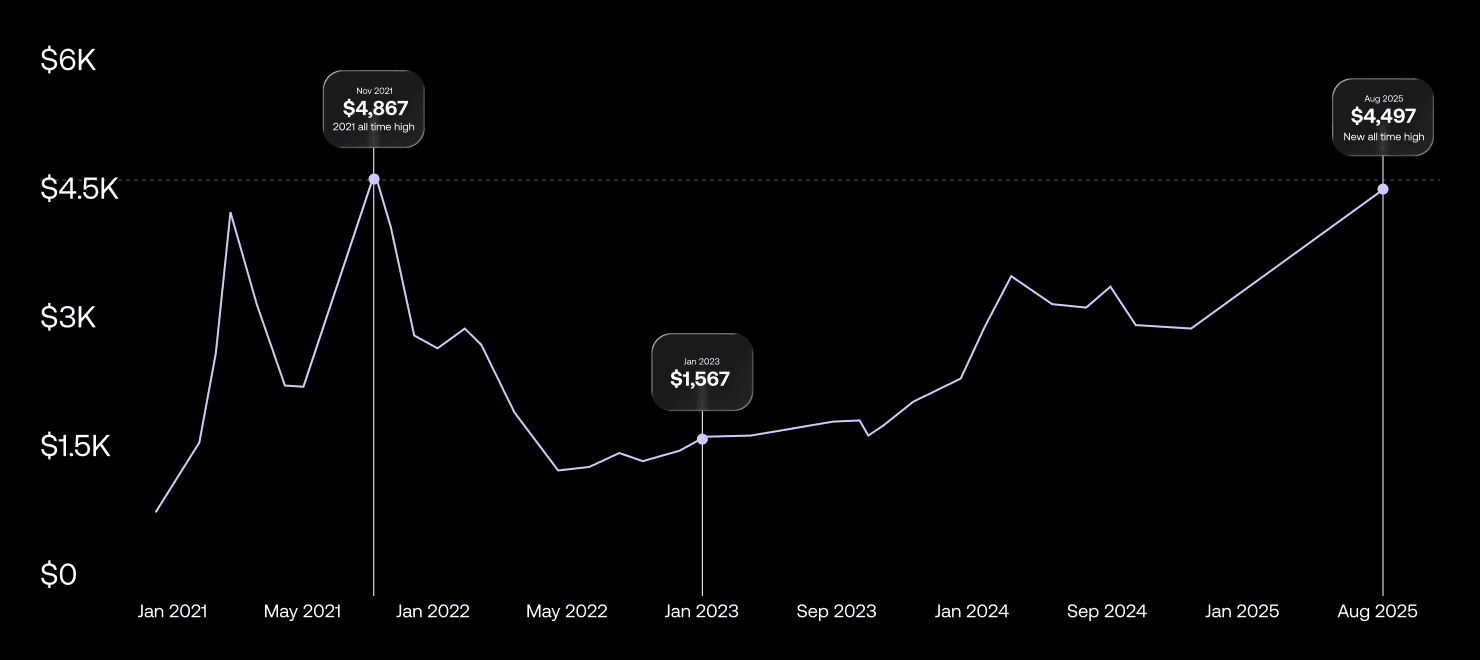
Ethereum traded below $1 in its early years, then rose across multiple cycles as new use cases emerged and liquidity grew. The prior cycle saw an all-time high above $4,800 in November 2021, followed by large drawdowns that are common in digital asset markets.
Ethereum reached a new all-time high in August 2025, surpassing its previous 2021 record and trading at roughly $4,950. The milestone marked a new peak after nearly four years below its prior high.
Price has been sensitive to macro conditions, protocol milestones, adoption of decentralized applications, and demand for block space. Past performance does not predict future results. This article is for education purposes only and not investment advice. We always recommend you do your own research before investing.
Ethereum future: what to expect
Ethereum’s next major upgrade is Glamsterdam. As of September 2026, it is being tested and is expected on mainnet in Q4 2026, although the date has not yet been confirmed.
Glamsterdam’s headline changes include the enshrining of proposer-builder separation and block-level access lists. The upgrade is designed to improve how blocks are built, prepare Ethereum for greater parallel processing, and support higher layer one capacity.
Hegotá is currently expected in Q2 2027, although the date is not yet confirmed. Fork-choice enforced inclusion lists focused on censorship resistance and frame transactions are among the changes currently scheduled. Its scope is still being finalized, so features and timing may change before mainnet.
What is the future of Ethereum value
Value depends on real demand for block space, application utility, and broader market conditions. If more activity moves to rollups that settle to Ethereum, demand for data and settlement can support the network economy over time. None of this is guaranteed, and you should do your own research.
Risks or challenges in Ethereum’s future
Key risks include client monocultures that can create single points of failure, concentration among Ethereum staking providers, and incentives around maximal extractable value that can compromise neutrality and the user experience. Work on client diversity and protocol-level mitigations remains important.
Fragmentation across many layer twos can create challenges for liquidity and user experience. Regulatory changes and security issues in applications also present ongoing risks. Users should stay informed, use trusted tools, and understand the risks involved before investing in Ethereum or any cryptocurrency, however well-established.
Ethereum calculator
Use our free Ethereum Profit Calculator to see the dollar and percentage gain or loss for any planned or completed ETH trade. Enter your buy price, sell price, trade size, and fees, pick your currency, and get instant results with no wallet connection or sign-up required.
Tax implications on Ethereum
For United States taxpayers, digital assets are treated as property. Selling ETH for cash, swapping ETH for another token, or spending ETH on goods or services are taxable disposals that create capital gains or losses based on cost basis and proceeds. Accurate records in United States dollars for dates, amounts, and fees are essential.
Crypto staking rewards are generally taxable as ordinary income when you have dominion and control over them. A later sale or swap of those rewarded coins is a separate capital gain or loss measured from the income value to the disposal value. Consult a qualified crypto tax professional for your specific situation.
Ethereum history FAQs
Will Ethereum surpass Bitcoin?
How does Ethereum's smart contract functionality impact its value?
What are the risks associated with investing in Ethereum?
Will my ETH automatically convert to ETH2
Is converting ETH to ETH2 taxable
What major Ethereum upgrades came after the Merge?
What is Ethereum 2.0 called now?
To stay up to date on the latest, follow TokenTax on Twitter @tokentax.
Related Content
